So you’ve found the perfect candidate on paper, now what?
The interview process is one of the most critical parts of the recruitment stage as it can help determine if the applicant's experience, skills, and personality meet the job’s requirements and if they are an overall good fit for the position.
Careful planning for an interview is strongly recommended including being mindful of the questions to ask and the ones to avoid.
Do Ask:
Is there any reason you would not be able to work on any particular day or time?
Why leave your current / previous employer/s?
Are you able to get to and from work without difficulty?
Is there anything else we should be aware of that may impact your ability to fulfil the role?
Do you have any holidays or prior commitments that will impact the role?
How would your current employer describe your work and contribution?
We have a lot of tourists, do you speak any other languages?
Don’t Ask:
Are you married? Do you have children?
What does your partner do for work?
Are you able to start at 8am or do you need to drop kids off at school?
I love your accent, where are you from?
Is English your first language?
Do you have any disabilities?
What is your sexual preference?
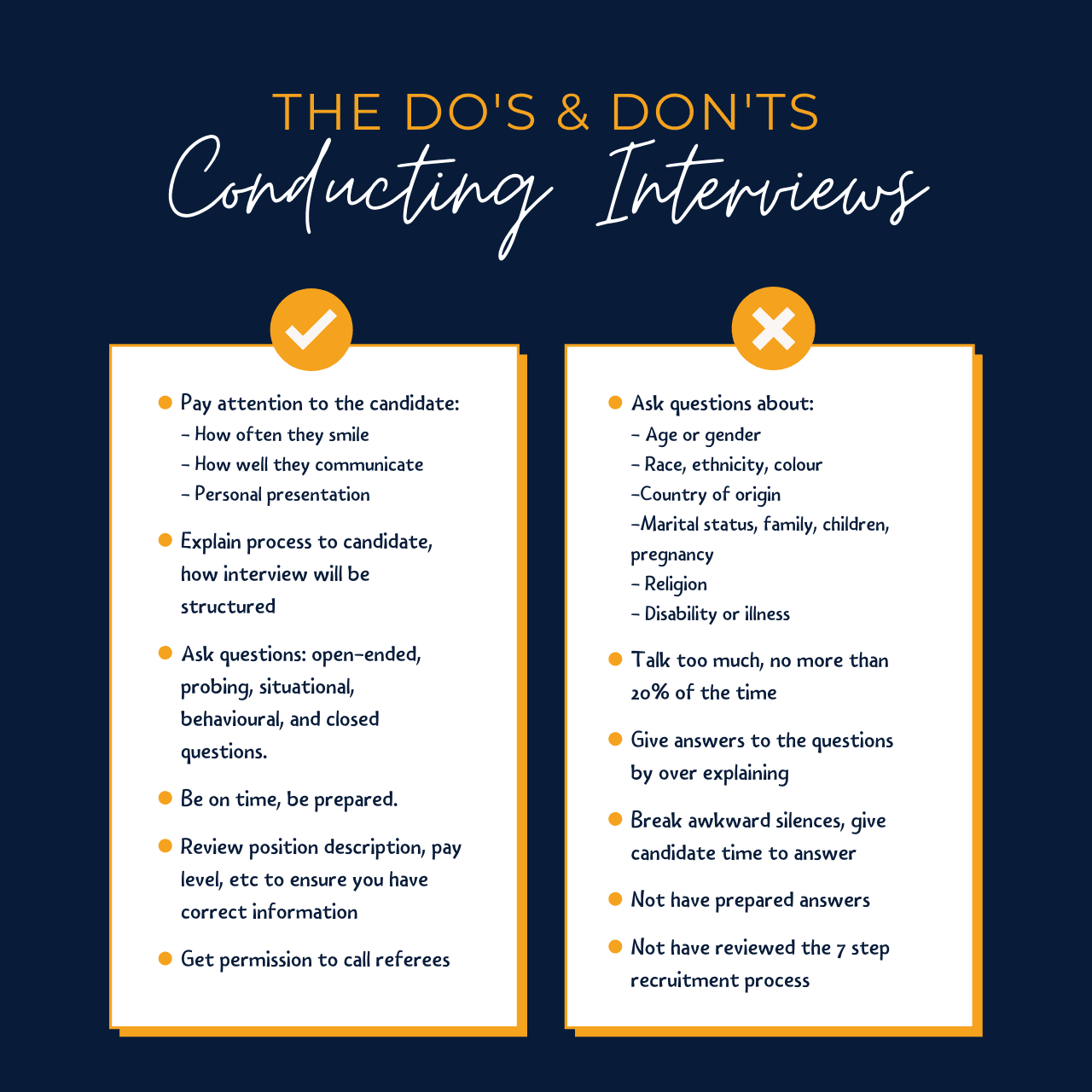
Questions like these should be avoided. Employers should focus on a candidate’s ability to perform the role and avoid unnecessary questions regarding age, gender, race, ethnicity, colour, country of origin, marital status, family, children, pregnancy, religion, disability or illness.
Interview Tips
Have a question and assessment form ready with easy fill out sections giving ratings for standard areas such as presentation, communication, confidence. Fill it out immediately after the interview to ensure it’s fresh in your mind.
Don’t skip the referee check, don’t rely on written references.
Always contact the unsuccessful candidates, the interview may be a big deal for them and when they do not get a timely reply it can cause reputation damage.
Trust your instincts.
Remember! A brief, supervised work trial may be unpaid where it is only necessary to demonstrate the skills required for the job. Any work beyond what is reasonably required to demonstrate those skills must be paid.
Types of Questions
Leading Questions
Leading questions imply the answer the interviewer wants to hear rather than obtaining the candidate’s true opinion.
I suppose you enjoyed working as a part of a team, did you?
You wouldn’t mind working some overtime, would you?
Closed Questions
Closed questions elicit a yes or no response, and do not require the candidate to elaborate with more information.
Are useful for confirming information
Limit the information drawn from a candidate
Open Questions
Open questions cannot be answered with a simple “yes or no”. They are designed to draw a full, meaningful answer using the subject’s own knowledge.
Tell me about…
How did you..?
What did you do?
Can you explain
Give me an example of...
Describe a situation when...
Theoretical Questions
Theoretical questions encourage applicants to voice their opinion or view.
What a person would like to do, thinks should be done or should have done
Has the applicant learned from past mistakes? What is their self-awareness?
Behavioural Questions
Past actions often indicate future actions.
Does their approach fit in with your company culture and values?
Are the examples and experiences they are providing at the level that you would expect the role to perform?
Redirecting Questions
Can you tell me about one specific example?
Do you have another example?
And what was your role in this project?
Tell me what your contribution was…
You said you had a bad boss, what characteristics of their leadership made you feel that way?
You said the work environment was unpleasant, what made it unpleasant or what was it that you did not like?
I hope this has been helpful and remember, if you need any help or advice In recruiting the right candidate, please reach out!