Workplace Investigations
When it comes to conducting workplace investigations, adherence to fundamental principles is paramount. These principles serve as the bedrock upon which a fair and thorough investigation process is built. In this comprehensive guide, we will explore the essential principles that underpin effective workplace investigations.
From the delicate balance of probabilities to the imperative of procedural fairness, we'll delve into each aspect that ensures a just and well-documented investigation. Whether you're a manager, or an employee, understanding these principles is vital for upholding integrity and fairness within the workplace.
Basic Principles
Balance of probabilities and reasonable person's test
✓ A fair investigation process should apply procedural fairness and natural justice to respondents as well as complainants:
The Hearing Rule
The No Bias Rule
The Evidence Rule
✓ Must execute a Duty of Care:
Clear and concise explanation of process
Must not isolate or treat respondents differently
Must provide equal support to complainants and respondents
Must update the respondent throughout the process
EAP or Counselling Services
✓ Must be closed out properly to avoid recycling of issues
When in doubt, investigate!
If the matter is serious
If an internal policy or external body requires investigation
If the result could be termination of employment. Remember, the Investigation and the Disciplinary Process are two separate processes
The evidence is so clear, obvious or persuasive that the employee would not have a reasonable response - investigation may not be required.
Planning An Investigation
Before you start, consider:
✓ Do you have allegations or do you need to ascertain the allegations
✓ Seriousness of the matter (do you need legal privilege?)
✓ Complexity and likelihood of counter allegations
✓ Availability of internal staff (i.e., do you have the time to do it properly?)
✓ Experience of the Investigator and knowledge of policies / external body requirements (external appointment)
✓ Are there conflicts of interests / perceptions of bias of the Investigator
Who is the Decision Maker:
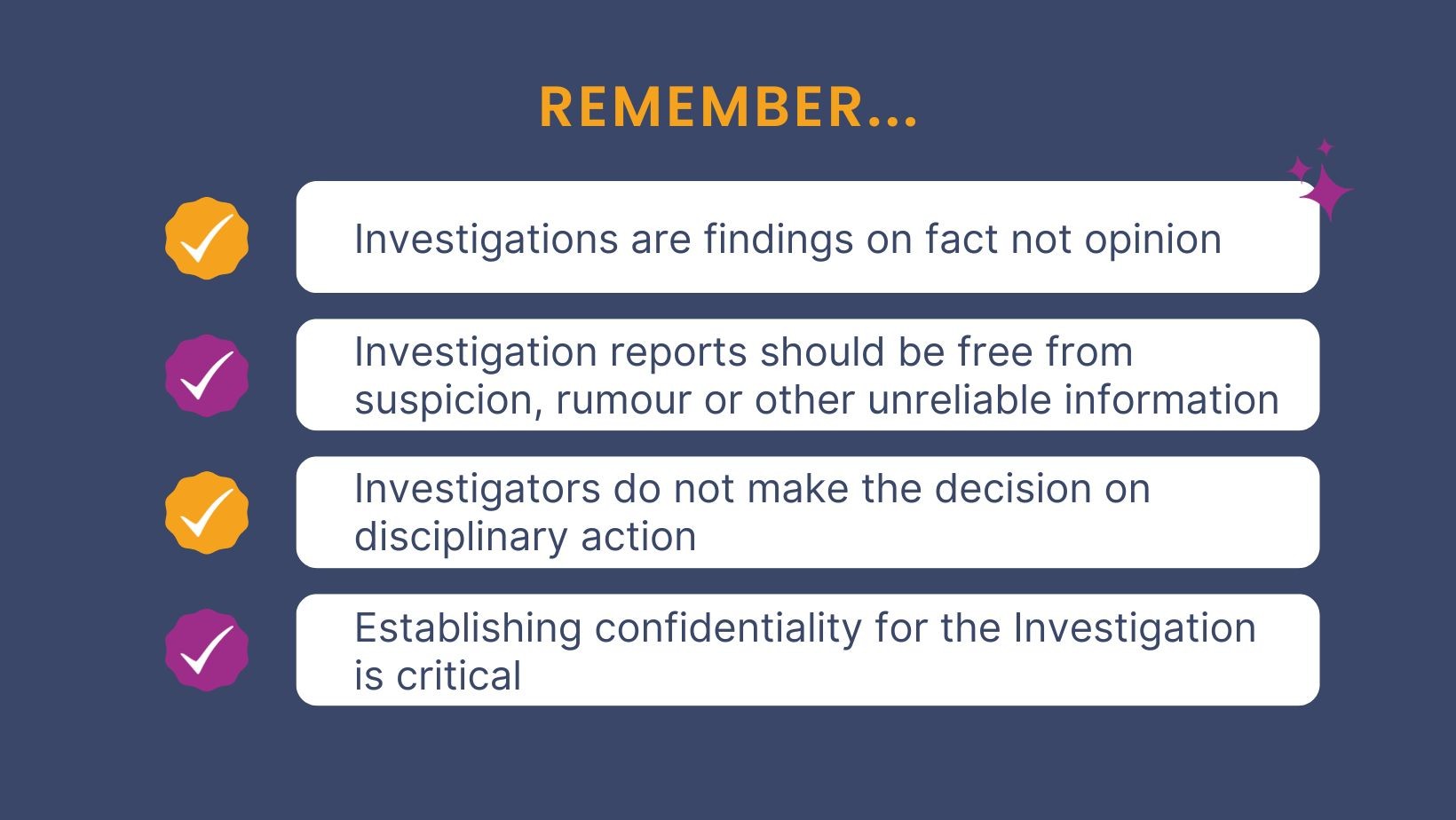
✓ The Decision Maker and Investigator are two separate role
✓ The Decision Maker should be neutral party and not have a stake in the outcome making a decision on the findings of the Investigation
Scoping the Investigation
✓ Establishes the parameters of the matter so things are not missed or dragged out
✓ Provides clear allegations that will be investigated (who/what/what/where/when)
✓ Consider what witnesses may be needed
✓ Logistics of undertaking the Investigation
✓ Provides clarity to the Investigator and Decision Maker on limits of what is being investigated
✓ Stops multi-matters becoming intertwined (past issues come into the decision not the investigation)
✓ Scope can be revised during the process
Document, Document, Document
✓ Documentation is evidence and evidence supports findings. Without documentation, it can be difficult to demonstrate what occurred.
✓ Primary goal is to create a verifiable record on the Investigation
✓ Document your investigation steps / process (timeline and include the timeline in the investigation report)
✓ Texts, emails, voicemails, CCTV it is all evidence
✓ Interviews can be recorded with consent and the participant being provided with access (unless directed otherwise by legal privilege)
✓ Evidence should be attached to the Investigation Report or screenshot into the Investigation Report
✓ Objective and free from perceived bias
Investigation Interviews
✓ Gather pre-existing evidence
✓ Invite to interview, offer support person and remind of confidentiality
✓ Interview in person wherever possible
✓ Interview order: Complainant/Witnesses/Respondent
✓ Provide the allegations to the Respondent before interview
– important to be procedurally fair
✓ Open questions related to the allegations (what/where/when/how)
✓ Plan your questions to align to the allegations to avoid things being missed
✓ Use words like ‘Can’ you describe, ‘Can you explain?’, ‘Can you provide evidence?’
✓ Listen actively (recording interviews may help with being able to listen)
✓ Be respectful
Investigation Reports
✓ Assume they will be disclosable in a court of law
✓ Provide a concise executive summary or conclusion summary
✓ Document the methodology
✓ Document your standard of proof (balance of probabilities)
✓ Document your value of evidence
It is firsthand?
It is corroborated?
It is credible?
✓ Document Findings:
Substantiated
Unsubstantiated
Inconclusive
If you ever find yourself in need of assistance or advice when conducting an investigation, don't hesitate to reach out. Upholding these principles ensures fairness, transparency, and the preservation of integrity in every workplace investigation you undertake.
Contact: hello@hrdynamics.com.au or you can call HR Dynamics on 1800 877 747